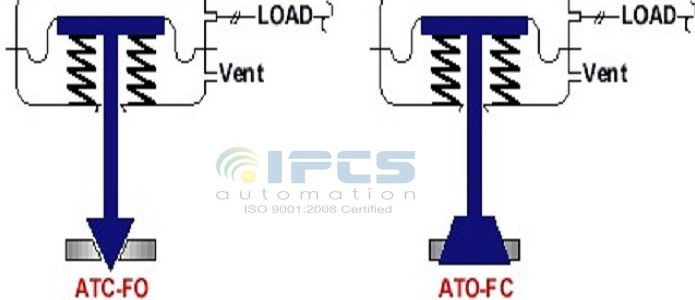
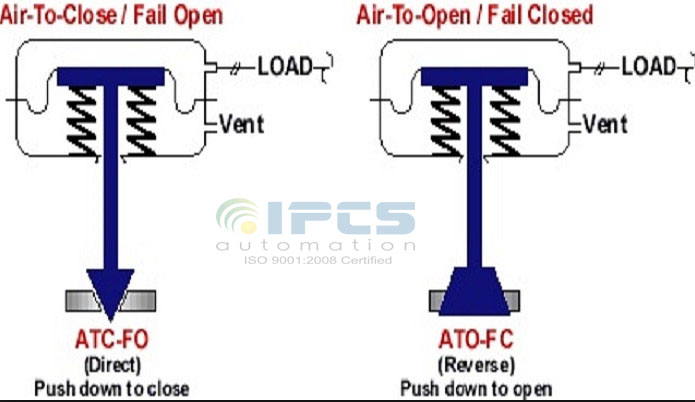
Control valves come in two sorts: air to open, and air to close. Air to open valves are normally held closed by the spring and require air pressure (a control signal) to open them – they open progressively as the air pressure increases. Air to close valves are valves which are held open by the valve spring and require air pressure to move them towards the closed position. The reason for the two types of valves is to allow failsafe operation. In the event of a plant instrument air failure it is important that all control valves fail in a safe position (e.g. an exothermic reactor’s feed valves (or, perhaps, just one of the valves) should fail closed (air to open) and its coolant system valves fail open (air to close)). The type of valve used obviously impacts on what a controller has to do – changing the type of valve would mean that the controller would need to move the manipulation in the opposite direction. To simplify things in this course we shall assume that we are always using air to open valves – an increase in control action will cause the valve to open and the flow through it to increase.
Summary
Article Name
Air to open and Air to close Control Valve
Description
Control valves come in two sorts: air to open, and air to close. Air to open valves are normally held closed by the spring and require air pressure (a control signal) to open them - they open progressively as the air pressure increases.
This may be a good place to introduce yourself and your site or include some credits.
Search
Automation Training
Our foundation-to-advanced automation course training covers end-to-end industrial workflows used in modern plants. Learners practice the full cycle from basic circuits to commissioning and maintenance with hands-on labs, project-based fault finding, SOP creation, and documentation exposure (URS, FDS, FAT/SAT).
PLC Training
This PLC training builds controller fundamentals with ladder, FBD, and ST, including I/O wiring, PID tuning, diagnostics, and version control practices on live rigs.
SCADA Training
Our SCADA course covers tag databases, HMI graphics, historian/trends, alarm rationalization, redundancy, user security, backups, and deployment aligned to plant standards.
Panel Designing
This panel design course teaches standards-compliant MCC/PLC panel engineering, SLD/GA/wiring docs, device selection, heat-load, testing, and FAT.
BMS & Security
BMS training focuses on HVAC/lighting/utilities automation; CCTV & security covers design, storage, networking, and analytics.
IIoT
The Industrial IoT diploma spans sensors-to-dashboard pipelines: MQTT/OPC UA, gateways, historians, alerts/KPIs, and predictive maintenance basics.