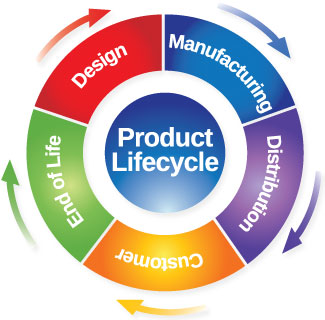
In industry, product lifecycle management (PLM) is the process of managing the entire lifecycle of a product from inception, through engineering design and manufacture, to service and disposal of manufactured products.PLM integrates people, data, processes and business systems and provides a product information backbone for companies and their extended enterprise. The inspiration for the burgeoning business process now known as PLM came from American Motors Corporation (AMC).
Product lifecycle management (PLM) is a systematic approach to managing the series of changes a product goes through, from its design and development to its ultimate retirement or disposal. PLM describes the engineering aspect of a product, from managing descriptions and properties of a product through its development and useful life; whereas, PLCM refers to the commercial management of life of a product in the business market with respect to costs and sales measures. Product lifecycle management can be considered one of the four cornerstones of a manufacturing corporation’s information technology structure.All companies need to manage communications and information with their customers (CRM-customer relationship management), their suppliers and fulfillment (SCM-supply chain), their resources within the enterprise (ERP-enterprise resource planning) and their product planning and development (PLM). PLM as a discipline emerged from tools such as CAD, CAM and PDM, but can be viewed as the integration of these tools with methods, people and the processes through all stages of a product’s life.PLM should not be seen as a single software product but a collection of software tools and working methods integrated together to address either single stages of the lifecycle or connect different tasks or manage the whole process.
In industry, product lifecycle management (PLM) is the process of managing the entire lifecycle of a product from inception, through engineering design and manufacture, to service and disposal of manufactured products.
This may be a good place to introduce yourself and your site or include some credits.
Search
Automation Training
Our foundation-to-advanced automation course training covers end-to-end industrial workflows used in modern plants. Learners practice the full cycle from basic circuits to commissioning and maintenance with hands-on labs, project-based fault finding, SOP creation, and documentation exposure (URS, FDS, FAT/SAT).
PLC Training
This PLC training builds controller fundamentals with ladder, FBD, and ST, including I/O wiring, PID tuning, diagnostics, and version control practices on live rigs.
SCADA Training
Our SCADA course covers tag databases, HMI graphics, historian/trends, alarm rationalization, redundancy, user security, backups, and deployment aligned to plant standards.
Panel Designing
This panel design course teaches standards-compliant MCC/PLC panel engineering, SLD/GA/wiring docs, device selection, heat-load, testing, and FAT.
BMS & Security
BMS training focuses on HVAC/lighting/utilities automation; CCTV & security covers design, storage, networking, and analytics.
IIoT
The Industrial IoT diploma spans sensors-to-dashboard pipelines: MQTT/OPC UA, gateways, historians, alerts/KPIs, and predictive maintenance basics.